Famous Ads and Advertising Campaigns of All Time, With Examples by Era
Famous ads rarely start famous. A small car told readers to think small, a hamburger chain asked where the beef was, and a deodorant brand answered fans one video at a time. These famous advertisements and campaigns, credited by brand and year, show which ideas lasted from 1947 to the Super Bowl of February 2026.
Why some famous ads last for decades
Most ads are forgotten within a week. The famous advertising campaigns of all time that survive for decades tend to share one trait: a single idea simple enough to repeat in conversation. Think small. Where’s the beef? Just do it. Each could be retold in a sentence by someone who had never seen the original ad.
A second trait is timing. Volkswagen sold a small car to Americans who were tired of chrome fins. Dove questioned retouched faces just as photo editing became routine. Many of the famous advertisements on this page arrived at a moment when audiences were already halfway to the same thought, and the ad simply finished the sentence for them.
The third trait is less flattering: big budgets. Apple bought a Super Bowl slot in 1984, and Coca-Cola filmed a choir on an Italian hillside in 1971 for what its history calls several hundred thousand dollars. A great idea seen by few people stays unknown, so this list of famous ads leans toward brands that could afford to be seen.
Early examples of famous advertising campaigns: 1947 to 1962
De Beers introduced the line A Diamond Is Forever in 1947. It tied a stone to permanence at a time when engagement rings were not yet universal, and it is still in use in some form. Clairol followed a decade later with Does she or doesn’t she?, a question about hair colour so discreet it worked as a joke.
Marlboro reinvented itself in the mid-1950s with a cowboy. The cigarette had been sold as a mild brand for women, and a rugged rancher with a tattooed hand repositioned it almost overnight. Advertising Age later placed it among the century’s top campaigns. Several men who played the character died of smoking-related illnesses, which now colours every look back at it.
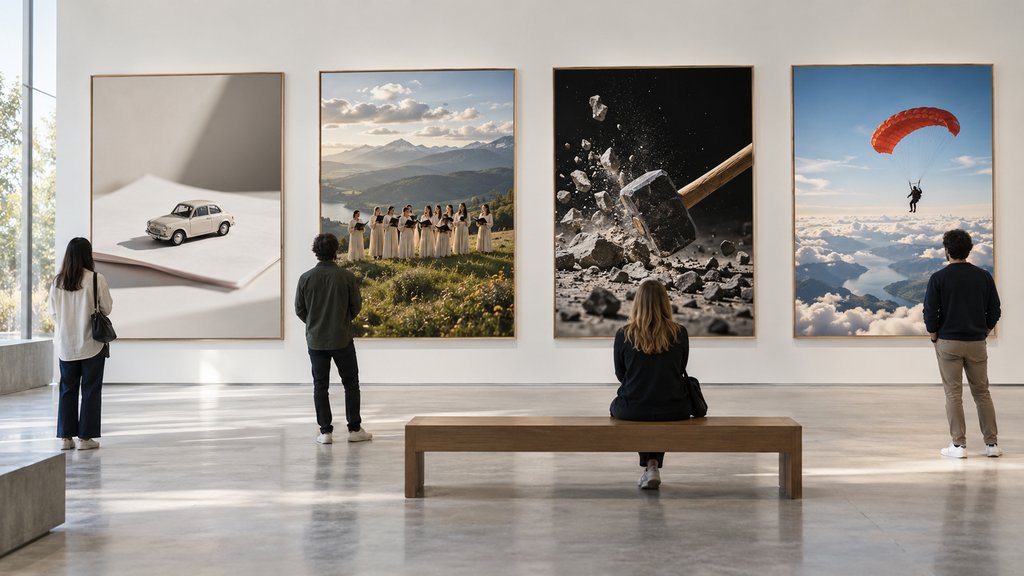
The most influential of the period is Volkswagen’s Think Small from 1959. A tiny Beetle sat in a sea of white space above a short headline, and the copy admitted that the car was small and plain. In 1999, Advertising Age ranked it first among the hundred best campaigns of the twentieth century, ahead of every television commercial.
Avis took the same honest tone in 1962. It was the second-largest car rental company behind Hertz, and its ads said so, arguing that second place made its staff work harder. The line ran in the United States for about fifty years before being replaced in 2012, and Avis later revived it for European television.
The thread connecting these examples is a willingness to say something slightly unexpected. A brand admitting it was small or second was surprising in the 1950s, because most advertising promised to be the biggest and best. The guide to 1960s advertising and the creative revolution follows that shift through the following decade in more detail.
Coca-Cola’s hilltop and the songs of the 1970s
Coca-Cola’s own history traces I’d Like to Buy the World a Coke to January 18, 1971, when fog forced a flight bound for London to land in Shannon, Ireland. Stranded passengers sharing drinks gave a writer the idea. The commercial, filmed with young people on a hill outside Rome, aired in the United States in July 1971.
The response was unusual. Coca-Cola and its bottlers received more than 100,000 letters about the commercial, and a version without the brand name, recorded as I’d Like to Teach the World to Sing, became a radio hit. Its song is covered in the guide to advertising jingles that became hits, next to its 1970s rivals.
It is worth pausing on how strange the hilltop spot is. It barely shows anyone drinking, has no product claim and no price. It sells a mood of togetherness in the year after Kent State and during the Vietnam War. Nostalgia has smoothed that context away, but in 1971 the gentle message was a deliberate contrast to the evening news.
The 1980s: beef, a sledgehammer and a vodka bottle
Absolut started its print series in 1980 with a photo of the bottle under a halo and the words Absolut Perfection. Over roughly twenty-five years the brand produced more than 1,500 variations, each built on the bottle’s outline: a pool shaped like it, a city skyline shaped like it, a puzzle missing one piece of it.
Wendy’s gave the decade its catchphrase in January 1984. Clara Peller, a retired manicurist in her eighties, peered at a giant bun and asked where the beef was. Within weeks, Walter Mondale used the line in a Democratic primary debate against Gary Hart. Few examples show more clearly how an ad line can leave advertising entirely and enter politics.
That month also brought Apple’s 1984, aired nationally once, during Super Bowl XVIII on January 22. A runner hurls a sledgehammer at a giant screen of a lecturing leader, and the Macintosh never appears. News programs replayed it for free. Later game-day spots are ranked in Super Bowl commercials, best and worst.
Nike closed the decade in July 1988 with Just Do It. The first spot showed Walt Stack, an 80-year-old San Francisco runner, crossing the Golden Gate Bridge and joking about chattering teeth. The line itself later became one of the best-known in the world, and its story appears in the guide to famous slogans and their brands.
The 1990s: milk, different thinking and a priceless line
The California Milk Processor Board launched Got Milk? in 1993 with a short film about a history buff who cannot say the answer to a radio quiz because his mouth is full of peanut butter. The question format was easy to copy, and it later travelled onto print ads with celebrities wearing milk moustaches.
Mastercard introduced Priceless in 1997. Each spot listed the cost of a few ordinary purchases and ended on something money could not buy. The structure was so clear that viewers began writing their own parodies, which is about the strongest compliment a campaign format can receive. The format outlived several changes of slogan around it.
Intel took a different route in 1991. It persuaded computer makers to place an Intel Inside sticker on their machines and mention it in their own ads, sharing the cost. A component nobody ever saw became a brand people asked for by name, and the five-note sound that followed in 1994 is still heard in 2026.
Apple’s Think Different arrived the same year, after Steve Jobs returned to the company. It showed black-and-white portraits of Albert Einstein, Martin Luther King Jr., Amelia Earhart and others under the brand’s logo. The grammar was criticized at the time, which only kept the line in conversation for longer, and the campaign helped reset Apple’s image before the iMac.
Budweiser’s Whassup? closed the decade, first airing in December 1999. Friends on the phone stretch a single greeting into a long shout, and the catchphrase turned up everywhere from playgrounds to talk shows within weeks. It is a reminder that some famous advertising campaigns are remembered for a sound instead of a sentence or a picture.
Famous advertising campaigns from Canada
Tim Hortons started Roll Up the Rim to Win in 1986 at 246 Canadian restaurants, with a snack pack of Timbits as the biggest prize. It grew into an annual ritual and, according to the company, had given away nearly 500 cars by 2011. The game moved online in 2020 and paper cups with rollable rims returned in 2025.
Molson Canadian’s The Rant debuted during the Academy Awards broadcast in March 2000. An ordinary man named Joe steps up to a microphone, calmly corrects American stereotypes about Canada and builds to a shout of national pride. Actors performed it live at hockey games that spring, and in 2025 the original spread online again during the trade dispute.
These two show different routes to fame: a promotion people join every spring, and a single sixty-second speech. Both depend on a sense of shared Canadian identity that American campaigns cannot borrow. More regional examples, from bank ads to public service spots, sit in the guide to Canadian commercials people still quote.
The 2000s and 2010s: real beauty, a horse and a space jump
Dove launched its Campaign for Real Beauty in 2004 with women of different ages, sizes and skin tones rather than models. Twenty years later, in April 2024, Dove pledged never to use artificial intelligence to create or alter images of real women in its ads. Few long-running brand ideas have turned into a public policy quite so directly.
Old Spice posted The Man Your Man Could Smell Like online on February 4, 2010, around Super Bowl XLIV. The real twist came months later, when the brand filmed 186 short personalized video replies to fans in about two and a half days. Body wash sales reportedly doubled by July 2010, according to figures published in its award entries.
Share a Coke began in Australia in 2011 by replacing the logo on bottles with 150 popular first names. Coca-Cola calls it the first major packaging change in its 125-year history, and the idea spread to more than 70 countries. You have probably looked for your own name on a shelf at least once, which was the entire point.
Red Bull Stratos, on October 14, 2012, needed no ad break. Felix Baumgartner jumped from a balloon capsule about 39 kilometres above New Mexico, and Guinness World Records counted more than eight million concurrent live streams on YouTube. Always followed in June 2014 with #LikeAGirl, which asked what the phrase meant and ran a 60-second version at Super Bowl XLIX.
Recent examples of famous advertising campaigns: 2024 to 2026
Duolingo announced in February 2025 that Duo, its green owl mascot, had died after being hit by a Tesla Cybertruck. Users could revive him by earning 50 billion experience points in lessons, and passed that target within about a week. The stunt is covered in more depth in the history of brand mascots and their comebacks.
At Cannes Lions in June 2025, the insurer AXA won the Titanium Grand Prix for Three Words, which changed home insurance policies to help people leaving domestic violence. L’Oréal won a Film Grand Prix for a documentary about Ilon Specht, who wrote Because I’m Worth It in 1971. Juries rewarded both new policy and old memory.
Super Bowl LX, on February 8, 2026, was the priciest showcase yet, with 30-second slots near $8 million. Budweiser’s American Icons topped the USA Today Ad Meter, and Lay’s Last Harvest came second. OpenAI, Anthropic, Google, Amazon and Meta made artificial intelligence the busiest category, a shift traced in the guide to AI in advertising as of 2026.
Public service examples that worked like brands
Some of the most durable campaigns sell no product. Smokey Bear first appeared for the US Forest Service in 1944, and his line about preventing forest fires dates from 1947. In 2001 the wording changed to wildfires, to cover grassland and brush. The bear is now older than most of the brands on this page.
Public campaigns borrow every trick that commercial ones use: a mascot, a repeated line, a simple instruction. The difference is how success is measured. A soft drink counts cases sold, while a fire prevention campaign counts fires that never started, which is almost impossible to prove. That uncertainty is exactly why such campaigns tend to run unchanged for so long.
The most famous advertising campaigns of all time, in one table
The table lists the famous ads above in date order, by brand and year, with the idea a viewer would remember. It is not a ranking. Rankings change with every new poll, while the dates and ideas stay fixed, and that makes this version more useful as a reference for anyone comparing campaigns across eras.
| Year | Brand | The idea people remember |
|---|---|---|
| 1947 | De Beers | A diamond is forever |
| 1959 | Volkswagen | Think Small |
| 1962 | Avis | Proud to be number two |
| 1971 | Coca-Cola | A hilltop choir |
| 1984 | Wendy’s | Where’s the beef? |
| 1984 | Apple | The hammer and the screen |
| 1986 | Tim Hortons | Roll Up the Rim to Win |
| 1988 | Nike | Just Do It |
| 1993 | California Milk Processor Board | Got Milk? |
| 2000 | Molson Canadian | The Rant |
| 2004 | Dove | Real Beauty |
| 2010 | Old Spice | Replies to fans |
| 2011 | Coca-Cola | Names on bottles |
| 2012 | Red Bull | Stratos jump |
| 2025 | Duolingo | The owl’s death |
Notice how many of the entries come from food, drink and personal care rather than cars or technology. Cheap, frequent purchases give a brand millions of chances a year to remind people of an idea, while a car buyer might see the ad once every few years. Apple and Volkswagen are exceptions that needed far more nerve.
Famous ads that went wrong
Not all famous ads are famous for the right reason. In April 2017, Pepsi pulled a commercial in which Kendall Jenner hands a can of soda to a police officer during a protest. Viewers said it trivialized demonstrations for social justice, and the company apologized within days, saying it had missed the mark and halting the rollout.
Coca-Cola’s AI-generated versions of Holidays Are Coming, released in November 2024 and again in 2025, were criticized as soulless, with viewers pointing to warped truck wheels and stiff faces. The brand kept going anyway, arguing that the tools were faster and cheaper. Whether audiences come round to the format is a question 2026 has not yet answered.
What the best examples leave out
Lists of famous ads tend to skip the slow, unglamorous work. Absolut ran its bottle ads for about twenty-five years. Avis used one line for about fifty. Tim Hortons repeated the same contest every spring for decades. Fame looks sudden from the outside, but most of these ideas were repeated for longer than many brands survive.
A small test: ask a friend which brand asked Where’s the beef? or Got Milk?, and many answer at once. Ask about a 2018 winner hailed as one of the best commercials of all time, and answers thin out. Repetition across years, more than prizes or budgets, seems to be what moves an idea into general memory.
There is also a sampling problem. These examples come mostly from North America and Europe, and from brands big enough to buy television time. Campaigns from India, Brazil or Nigeria that changed local habits rarely appear in English-language rankings. Which of the 2026 spots will still be remembered in 2050, and who will be compiling that list?
Questions about famous ads and campaigns
What is the most famous advertising campaign of all time?
No single answer is official, but Volkswagen's 1959 Think Small campaign comes closest. In 1999, Advertising Age ranked it first among the top 100 campaigns of the twentieth century. Coca-Cola's 1971 hilltop commercial, Apple's 1984 launch and Nike's Just Do It from 1988 appear near the top of most lists compiled since then.
What are the best commercials of all time?
Polls disagree, but a few names return on almost every list of the best commercials of all time: Apple's 1984, Coca-Cola's 1971 hilltop choir, Wendy's Where's the beef? and Old Spice's The Man Your Man Could Smell Like from 2010. Each is remembered for one line or one image that viewers could repeat to a friend the next day.
What are some examples of successful advertising campaigns?
Strong examples include Old Spice in 2010, whose body wash sales reportedly doubled within months, and Share a Coke, which began in Australia in 2011 and spread to more than 70 countries. Tim Hortons' Roll Up the Rim, launched in 1986 at 246 Canadian restaurants, ran for decades and became an annual national habit.
What were the best advertising campaigns of 2025?
Duolingo's staged death of its owl mascot in February 2025 drew enormous attention and pushed users to earn 50 billion experience points to revive him. At Cannes Lions in June 2025, the insurer AXA won the Titanium Grand Prix for Three Words, which changed home policies to help people leaving domestic violence.
What were the most talked about ads of 2026?
The Super Bowl LX broadcast on February 8, 2026, set the agenda. Budweiser's American Icons topped the USA Today Ad Meter, Lay's Last Harvest came second, and Expedia's spot led YouTube views. Spots from OpenAI, Anthropic, Google and Amazon made artificial intelligence the most crowded product category of the night.
Why did Apple's 1984 ad become so famous?
It aired nationally only once, during Super Bowl XVIII on January 22, 1984, and never showed the computer it was selling. A woman throws a hammer through a screen of a lecturing figure while grey workers watch. The single broadcast turned it into news, and television stations replayed it for free in their reports.
What was the Where's the beef ad?
It was a 1984 Wendy's commercial in which actress Clara Peller, then in her eighties, inspects a huge bun holding a tiny patty and demands to know where the beef is. The line escaped advertising entirely. Walter Mondale used it against Gary Hart in a 1984 presidential primary debate to question his rival's policies.
What is the most famous Canadian ad campaign?
Molson Canadian's The Rant from 2000 is the usual answer. It debuted in Canada during the Academy Awards broadcast in March 2000 and was performed live at hockey games that spring. In 2025, during the trade dispute with the United States, the original spot spread across social media again, a quarter century later.
Do famous ad campaigns increase sales?
Some show clear results, others mostly fame. Red Bull's Stratos jump in 2012 earned global coverage that would have cost far more as paid media. Old Spice reported body wash sales up sharply in 2010. Other celebrated campaigns, especially award winners, publish little sales data, so their effect has to be judged indirectly.
Which famous campaigns failed?
Pepsi pulled a 2017 commercial starring Kendall Jenner within days after viewers said it trivialized protests for social justice, and the company apologized for missing the mark. Coca-Cola's AI-made holiday ads in 2024 and 2025 were criticized as soulless, though the brand kept the format. Failure is usually about tone, not production budget.
How long do famous campaigns usually run?
The longest-running ones last decades. Avis used its number two line in the United States for about fifty years before replacing it in 2012. Absolut's bottle-shaped print series ran for about twenty-five years and produced more than 1,500 executions. Most modern social campaigns, by contrast, peak within a few weeks.
What was the first Just Do It commercial?
Nike launched Just Do It in July 1988. The first spot showed Walt Stack, an 80-year-old San Francisco runner, crossing the Golden Gate Bridge and joking about his chattering teeth. The line itself later became one of the best-known slogans in the world, and it has outlasted the commercial that introduced it by several decades.
When did the Share a Coke campaign start?
Share a Coke began in Australia in 2011, when Coca-Cola replaced the logo on its bottles with 150 popular first names. The company calls it the first major packaging change in its 125-year history. The idea spread to more than 70 countries, and plenty of shoppers ended up scanning store shelves for a bottle carrying their own name.
What was the original Got Milk commercial?
The California Milk Processor Board launched Got Milk? in 1993 with a short film about a history buff who cannot say the answer to a radio quiz, because his mouth is full of peanut butter. The question format was easy to copy, and the campaign later moved onto print ads showing celebrities wearing milk moustaches.
Who wrote Because I'm Worth It for L'Oréal?
The line Because I'm Worth It was written in 1971 by Ilon Specht. More than fifty years later, at Cannes Lions in June 2025, L'Oréal won a Film Grand Prix for a documentary about her and the slogan. The same festival gave AXA the Titanium Grand Prix, so the juries rewarded new policy alongside old memory.
How old is the Smokey Bear campaign?
Smokey Bear first appeared for the United States Forest Service in 1944, and his line about preventing forest fires dates from 1947. In 2001 the wording changed to wildfires, to cover grassland and brush. As of 2026 the bear is more than eighty years old, older than most of the brands behind the other campaigns on this page.